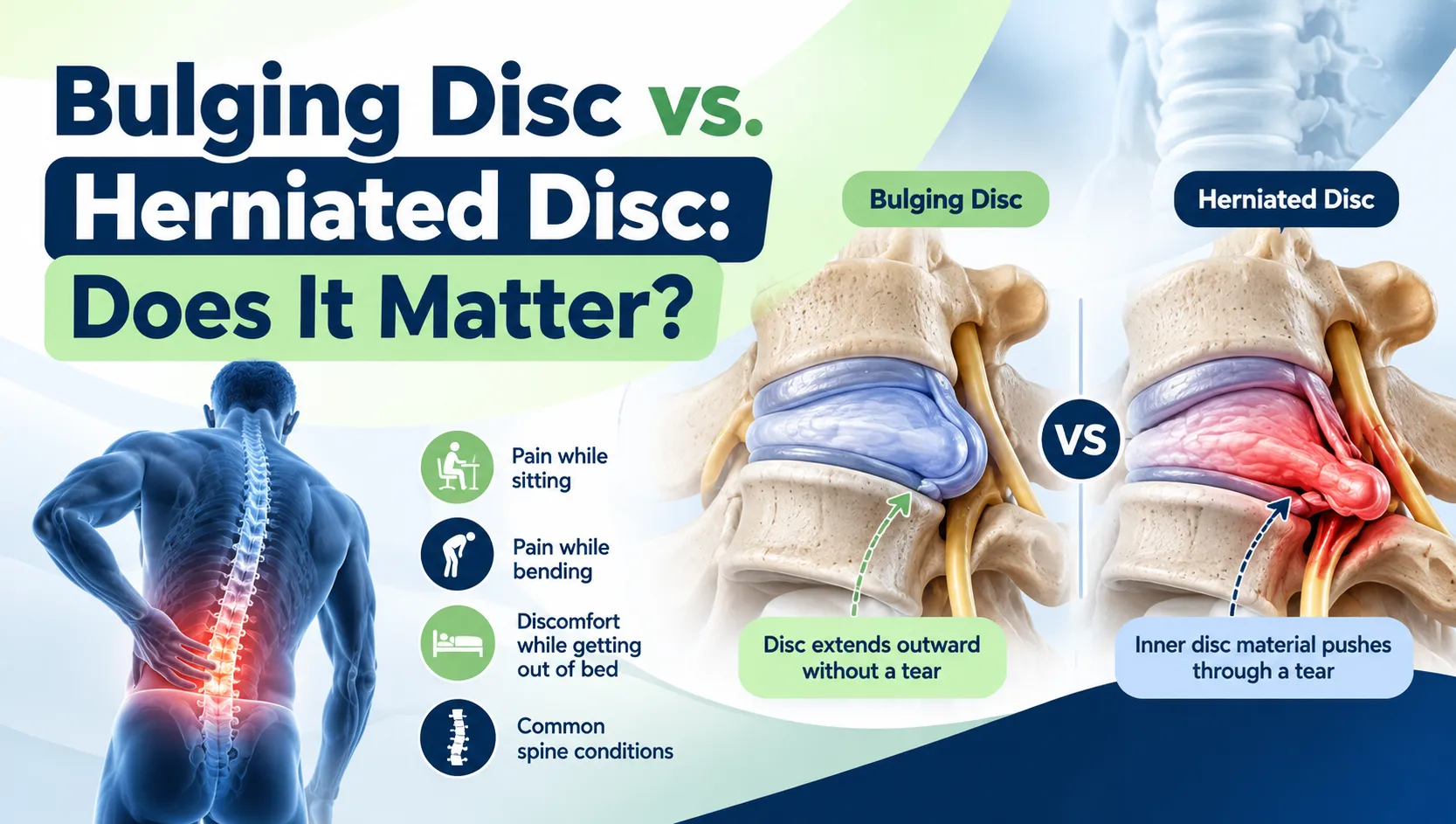
Yes, the difference between a bulging disc and a herniated disc matters structurally and symptomatically, although both can develop due to wear and tear on the spine.
Everyday activities like sitting for long hours, bending down, or getting out of bed can become difficult. An MRI may reveal a bulging or herniated disc, but the seriousness depends on its location, nerve compression, and the symptoms experienced.
What Is a Bulging Disc?
The spine consists of bones called vertebrae, with soft discs between them that act as cushions. These discs absorb shock, support movement, and help keep the spine flexible. Each disc has a soft inner centre surrounded by a tougher outer layer.
A bulging disc occurs when a disc extends beyond its normal boundary without necessarily tearing its outer layer. It is similar to a cushion that spreads outward under pressure.
Bulging discs often develop with age as the discs lose moisture and become less flexible. Everyday wear and tear or an injury can also contribute to the condition.
Many people with a bulging disc have no symptoms, and it may only be discovered during an MRI scan. However, if the bulge irritates or compresses nearby nerves, it can cause pain or other symptoms.
Symptoms depend on the disc's location. A bulging disc in the lower back may cause lower back pain that spreads to the buttocks or legs. In the neck, it may cause neck pain that travels to the shoulders, arms, or hands.
What Is a Herniated Disc?
A herniated disc occurs when the soft inner material of a spinal disc pushes through a tear or weak spot in its outer layer. This material may irritate or compress nearby nerves, leading to pain and other symptoms.
A herniated disc is also commonly called a slipped disc, although the disc does not actually slip out of place.
Herniated discs can develop in the neck or lower back. They may occur after sudden strain, such as lifting a heavy object, or develop gradually due to age-related changes in the spine.
Some herniated discs cause little or no discomfort, while others can lead to pain, tingling, numbness, or muscle weakness. For example, a herniated disc in the lower back may cause pain that travels down the leg.
The size of a herniated disc does not always determine the severity of symptoms. A small herniation near a sensitive nerve may cause significant pain, while a larger one may cause no noticeable symptoms.
Bulging Disc vs. Herniated Disc: Key Differences
The main difference is how the disc extends beyond its usual boundary. A bulging disc spreads outward, while a herniated disc involves inner disc material pushing through a weakened or torn outer layer.
|
Feature |
Bulging disc |
Herniated disc |
|
What happens? |
The disc extends outward beyond its normal edge |
Inner disc material pushes through a weakened or damaged outer layer |
|
Outer covering |
Usually remains intact |
Has a damaged or weakened area |
|
Common reasons |
Age-related changes, wear and tear, repeated strain |
Disc weakness, age-related changes, sudden strain or injury |
|
Symptoms |
May cause no symptoms or may irritate nearby nerves |
May cause no symptoms or may put pressure on nearby nerves |
|
Treatment |
Often starts with non-surgical care |
Often starts with non-surgical care |
|
Is surgery always needed? |
No |
No |
The terms describe different changes in a spinal disc, but neither one automatically means a person has a serious condition. The effect on nearby nerves and the symptoms being experienced are often more useful when planning treatment.
Symptoms of a Bulging or Herniated Disc
The symptoms can overlap, so it may not be possible to tell which condition is present just by how the pain feels.
Common symptoms include:
-
Pain in the lower back or neck
-
Pain that travels into the buttock, leg, shoulder, or arm
-
Tingling or a pins-and-needles feeling
-
Numbness in part of an arm, hand, leg, or foot
-
Muscle weakness in the affected limb
-
Pain that becomes worse with certain movements, coughing, or sneezing
However, not all patients exhibit all these symptoms; some may experience localized pain in the back and neck only, while others may experience pain shooting down their arms or legs.
Special attention must be paid to muscle weakness. When the patient has trouble moving his foot, his legs keep giving way, or he has trouble holding onto things, then there is no time to waste when consulting a doctor.
When there is back pain coupled with sudden trouble urinating, loss of bladder/bowel control, or numbness on the inner thighs/genitals, then one must seek urgent medical help.
What Causes These Disc Problems?
Degeneration due to age is a fairly common cause of disc herniation as well as disc prolapse because of gradual dehydration and loss of elasticity of the disc.
Some other causes and risk factors for this condition include:
-
Heavy lifting: Raising a heavy object using improper posture may put pressure on the vertebrae.
-
Physical strain: Some work activities and continuous bending and twisting may create pressure on the disc.
-
Accidents: Accidents and falls may lead to injury to the disc.
-
Prolonged sitting: Long periods of being immobile may worsen the pain in the back, especially if mobility is limited.
-
Overweight: Extra body weight may add extra pressure on the spine.
-
Smoking: Smoking is linked to poorer state of the disc and healing capacity of the body.
Usually, it happens that there is no particular cause of this problem; it takes several years for changes in the disc to occur.
How Are Bulging and Herniated Discs Diagnosed?
A spine specialist usually begins by asking about the pain, when it started, which movements make it worse, and whether it spreads into an arm or leg. The examination may include checking muscle strength, sensation, reflexes, walking, and certain movements.
An MRI scan can show the spinal discs, nearby nerves, and other soft tissues. It is often useful when symptoms suggest nerve compression, symptoms persist despite treatment, or surgery is being considered.
However, an MRI report should not be read in isolation. Disc bulges and herniations are also found in people who have no back pain. A scan may show a disc abnormality that is unrelated to the symptoms.
The doctor therefore compares the MRI findings with the patient's symptoms and examination results. For example, if pain and numbness affect one leg, the specialist checks whether the disc problem is in a position that could affect the nerve supplying that leg.
This connection matters more than the wording of the scan report alone.
Treatment Options for Bulging and Herniated Discs
Both conditions can often be managed without surgery. Treatment is chosen according to the severity of symptoms, the effect on daily activities, and whether nerve function is affected.
Medicines and Short-Term Pain Relief
A doctor may prescribe pain-relieving or anti-inflammatory medicines for a short time. These medicines should be used with caution because of potential side effects. The person’s tolerance for the medicines, as well as other health conditions, may affect the choice of medicine.
These medicines may provide symptom relief, but they do not put the disc in its original position. These medicines are generally used in combination with advice for movement, rehabilitation, and other methods.
Physiotherapy and Gentle Movement
Physiotherapy can help strengthen the muscles that support and take the load off the spine. Exercises can be tailored to a patient's symptoms and help target the areas of the spine that a patient is having problems with.
Long-term bed rest isn't usually helpful. However, gradually returning to normal activities (including walking) is usually recommended if the patient isn't experiencing a large worsening of symptoms.
Any exercises that cause an increase in the patient's pain (or other symptoms) traveling down the arm or leg should be stopped. These should be reviewed by a qualified professional.
Changes to Daily Activities
Small adjustments can make daily life easier while the spine recovers. Taking regular breaks from sitting, avoiding heavy lifting during a painful flare-up, and keeping loads close to the body may help.
There is no need to avoid all physical activity. The aim is to reduce movements that aggravate symptoms while gradually returning to comfortable, normal movement.
Other Treatments
In many cases where people suffer from chronic nerve pain, a doctor might think of giving an injection into the painful nerve area. However, this can only help for some time and does not work for everybody; it is not a permanent solution either.
What follows will depend upon the progress made with this treatment.
When Is Surgery Needed?
A bulging or herniated disc does not automatically require an operation. Many people improve with non-surgical treatment over time.
Surgery may be considered when:
-
Leg or arm pain remains severe despite an appropriate course of non-surgical treatment.
-
Nerve compression is causing significant or worsening muscle weakness.
-
Symptoms are seriously affecting walking, sleep, work, or everyday activities and the scan findings match the symptoms.
-
There is an urgent problem involving the nerves that control bladder, bowel, or leg function.
Conclusion
A bulging disc and a herniated disc are two separate things, but both may occur without any symptoms showing up. When pain, numbness, or muscle weakness occurs, the next thing to do is to check if a nerve close by is involved and to what extent it is affecting normal activities. The result of an MRI may be valuable, but it must be taken into consideration along with a physical exam and the patient’s history. Dr. Dheeraj Batheja, Spine Surgeon in Gurgaon with over 13 years of experience, can evaluate spine symptoms.
Frequently Asked Questions
Does lying down improperly exacerbate the pain from the disc?
Yes, since lying in an uncomfortable posture adds additional pressure to the spine or neck, causing the condition to worsen. It is advisable to sleep in a comfortable position and not cause any further pressure on the back.
Is it necessary for a person who has disc problems to stop bending?
No, since bending is one of the body's natural movements, and it is unnecessary to prevent bending altogether. If the condition causes pain, avoid any sudden movement and lifting of heavy objects. When the pain subsides, normal movements can gradually resume.
Are there any young adults who have disc problems?
Yes, since disc problems can happen at any age, even in young adulthood. Causes of disc problems include injury, heavy lifting, strain to the body, and changes in the discs.
Is it safe to drive a car if I have a bulging disc?
Driving short distances is usually alright, but long drives could exacerbate the condition. Make sure your seating is conducive to good posture and consider stopping for short walks. When pain is unbearable, or you are experiencing numbness, make sure you seek medical opinion before travelling.
Is it possible to have recurrent disc problems after treatment?
Yes, the problem can recur even after treatment has been successful. Strengthening back muscles, exercising, adopting proper lifting practices, and avoiding prolonged positions of the body may help prevent recurrence.
Related Blogs
Related Services