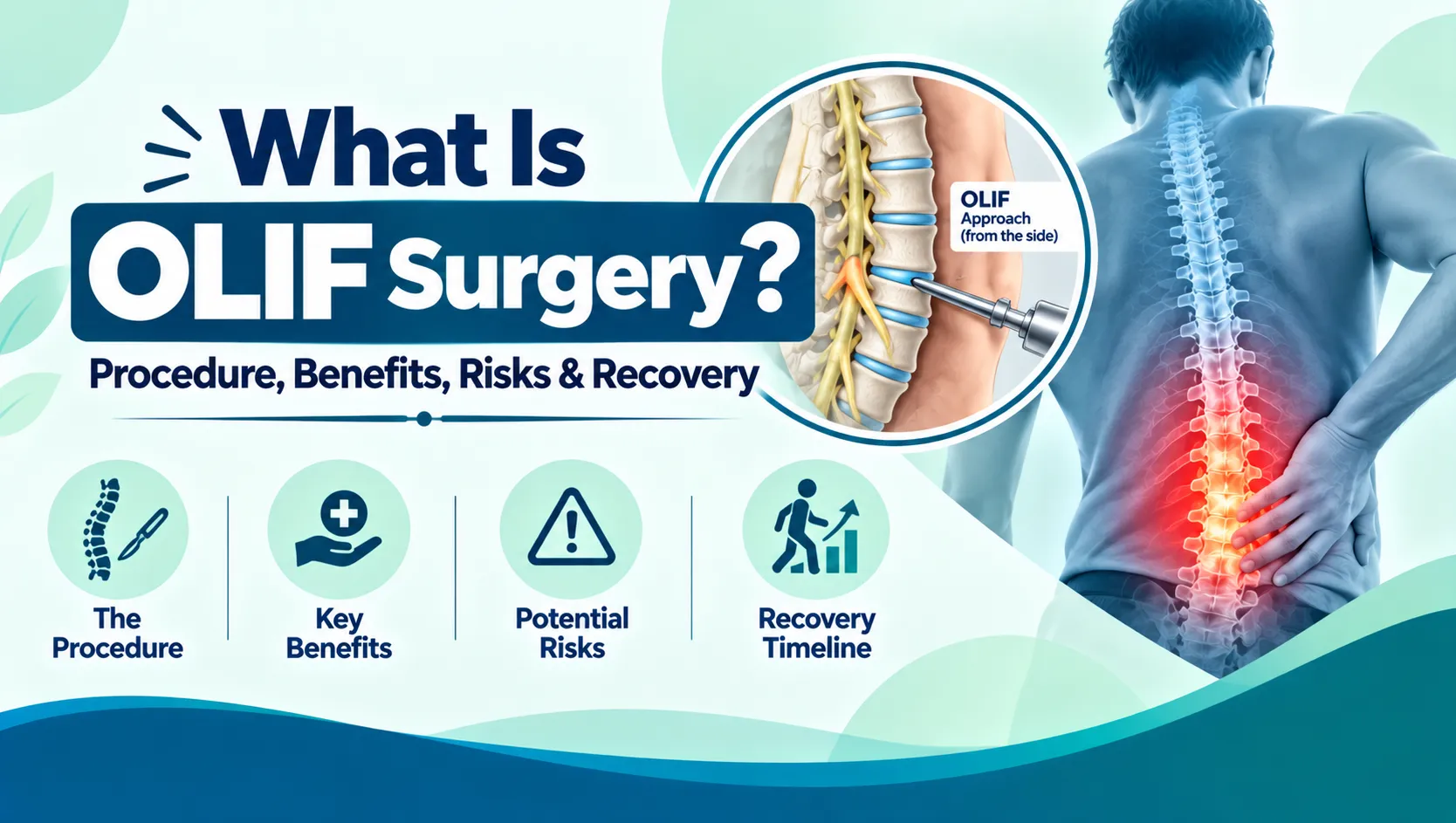
Oblique Lumbar Interbody Fusion (OLIF) is a minimally invasive spine surgery used to stabilize the lower back (lumbar) vertebrae and, in selected cases, help relieve pressure on spinal nerves. The procedure approaches the affected disc space through an oblique corridor from the side of the body and is used for certain lumbar spine conditions requiring fusion.
If you have been advised to consider OLIF surgery, you may want to understand how the procedure is performed, when it is recommended, its potential benefits and risks, and what recovery involves. In this guide, we explain the key aspects of OLIF surgery in simple terms.
What Is OLIF Surgery?
OLIF, or Oblique Lumbar Interbody Fusion, is a type of lumbar interbody fusion surgery. Unlike traditional spinal fusion approaches that reach the spine from the back, OLIF uses an oblique corridor through the retroperitoneal space to access the affected disc.
The surgical pathway is located between the major blood vessels and the psoas muscle. This approach allows the surgeon to reach the lumbar disc while avoiding direct passage through the psoas muscle and reducing disruption of some of the posterior spinal muscles and structures.
During OLIF surgery, the damaged disc is removed and an interbody cage or spacer containing bone graft material is placed into the disc space. The cage helps restore disc height and provides support while the vertebrae gradually fuse. Additional screws and rods may be used when greater spinal stability is required.
OLIF does not mean that every patient will need the same procedure. The choice of surgical approach depends on the underlying condition, spinal anatomy, level of disease, imaging findings and overall health.
When Is OLIF Surgery Recommended?
OLIF may be considered when conservative treatment has not adequately controlled symptoms and spinal fusion is appropriate for the underlying condition. It is commonly used for selected degenerative conditions of the lumbar spine and certain spinal alignment or stability problems.
Depending on the individual case, OLIF may be considered for:
-
Degenerative disc disease
-
Lumbar spinal instability
-
Selected cases of spondylolisthesis
-
Degenerative scoliosis and certain spinal deformities
-
Some cases of lumbar spinal stenosis
-
Disc-space collapse with loss of foraminal height
-
Selected revision spine surgery cases
-
Certain other degenerative lumbar spine conditions
OLIF can provide indirect decompression by restoring the height of a collapsed disc space and enlarging the space available for the nerves. However, indirect decompression is not appropriate for every type or severity of spinal stenosis. Severe central stenosis, certain bony compressive lesions and unfavorable anatomy may require another surgical approach.
A detailed evaluation and appropriate imaging are therefore important before deciding whether OLIF is suitable.
How Is OLIF Surgery Performed?
The exact surgical technique varies depending on the spinal level and the patient's anatomy, but OLIF generally involves the following steps:
1. Preoperative Planning
Before surgery, the spine surgeon reviews the patient's symptoms, medical history and imaging studies. CT or MRI and other imaging may be used to assess the disc, nerves, spinal alignment, bone quality and the position of important blood vessels.
The relationship between the major blood vessels and the psoas muscle is particularly important because the OLIF surgical corridor passes through this region.
2. Patient Positioning
The patient is positioned on their side, and the surgical level is confirmed using imaging guidance.
3. Accessing the Disc Space
A small incision is made on the side of the abdomen. The surgeon works through the retroperitoneal space and approaches the lumbar disc through the corridor located in front of the psoas muscle.
4. Removing the Damaged Disc
The affected disc material is removed, and the disc space is prepared to receive the interbody implant.
5. Placement of the Interbody Cage
A specially designed cage or spacer is placed into the disc space. Bone graft material is generally used to encourage fusion between the adjacent vertebrae.
6. Additional Spinal Fixation
Depending on the patient's condition and the stability required, additional fixation such as pedicle screws and rods may be performed.
The goal is to stabilize the affected spinal segment while restoring disc height and alignment. In appropriate patients, restoring disc height can also increase the space around compressed nerve roots and provide indirect decompression.
What Are the Benefits of OLIF Surgery?
One reason OLIF has become an option for selected lumbar spine conditions is that it provides access to the disc through an oblique, anterior-to-psoas corridor rather than directly through the posterior spinal muscles.
Potential benefits in appropriately selected patients may include:
-
Minimally invasive access: OLIF can be performed through relatively small incisions compared with some traditional open approaches.
-
Less disruption of posterior spinal muscles: The approach avoids the need to directly dissect through many of the posterior spinal structures.
-
Preservation of the psoas muscle: Unlike transpsoas lateral approaches, OLIF approaches the disc in front of the psoas.
-
Restoration of disc height: A large interbody cage can help restore the height of a collapsed disc space.
-
Indirect nerve decompression: Restoring disc and foraminal height may increase the space available for affected nerves.
-
Spinal alignment correction: The technique can help address certain sagittal or coronal alignment problems.
-
Potentially faster mobilization: Some studies have reported shorter hospital stays and quicker postoperative mobilization with OLIF compared with certain posterior fusion techniques.
These benefits do not mean that OLIF is automatically better than other fusion procedures. The appropriate technique depends on the patient's individual anatomy and condition.
What Are the Risks of OLIF Surgery?
Like any spine surgery, OLIF has potential risks and complications. Although the technique is designed to reduce disruption to certain muscles and neural structures, its surgical corridor is close to important blood vessels and abdominal structures.
Possible complications include:
-
Blood vessel injury
-
Nerve or neurological injury
-
Temporary thigh or groin numbness
-
Hip flexor or psoas-related weakness
-
Abdominal or peritoneal injury
-
Ureter or sympathetic nerve injury
-
Infection
-
Cage migration or subsidence
-
Failure of the vertebrae to fuse
-
Persistent or recurrent symptoms
-
Need for additional surgery
Vascular injury is an important approach-specific risk because the OLIF corridor lies close to major blood vessels. Patient-specific vascular anatomy therefore needs to be carefully assessed during surgical planning.
The risks vary according to the surgical level, number of levels treated, patient's anatomy, bone quality, medical conditions and whether additional procedures are performed.
Who May Not Be Suitable for OLIF?
OLIF is not suitable for every patient requiring lumbar fusion.
The surgical approach may be limited by:
-
Unfavorable blood vessel anatomy
-
Certain severe forms of spinal stenosis
-
High-grade spinal instability or spondylolisthesis
-
Significant bony compression requiring direct decompression
-
Previous abdominal or retroperitoneal surgery in some cases
-
Certain spinal deformities requiring a different surgical strategy
-
Poor bone quality or other factors affecting implant stability
This does not mean that a patient with one of these factors can never undergo OLIF. The final decision depends on detailed imaging, clinical examination and the surgeon's assessment.
OLIF vs Other Lumbar Fusion Surgeries
OLIF is one of several approaches used for lumbar interbody fusion. Other commonly used techniques include TLIF, PLIF, ALIF and LLIF.
The main difference is the route used to reach the disc:
-
OLIF: approaches the disc through an oblique corridor in front of the psoas.
-
LLIF: generally approaches the disc from the side through or around the psoas, depending on the technique.
-
ALIF: approaches the lumbar disc from the front of the spine.
-
TLIF: reaches the disc through a posterior approach, usually from one side.
-
PLIF: reaches the disc through a posterior midline approach.
Each technique has different indications, advantages and risks. There is no single fusion approach that is appropriate for every patient.
Research comparing OLIF with TLIF has found differences in measures such as disc height, foraminal height and hospital stay, while fusion rates, complication rates and back-pain improvement were not significantly different in one meta-analysis. The evidence remains dependent on patient selection and study design.
OLIF Surgery Recovery
Recovery after OLIF varies depending on the patient's condition, number of spinal levels treated, additional fixation or decompression, general health and individual healing.
Immediately After Surgery
Patients are monitored after surgery, and pain management is provided. Early movement and walking may be encouraged when medically appropriate.
During the First Few Weeks
Activity is gradually increased according to the surgeon's instructions. Patients may need to avoid heavy lifting, excessive bending and twisting during the early recovery period.
During the Following Weeks and Months
Follow-up appointments help the surgeon monitor symptoms, spinal stability and the progress of fusion. Physiotherapy or rehabilitation may be recommended depending on the individual's needs.
Bone fusion itself takes longer than the initial recovery from the operation. Therefore, feeling better after surgery does not necessarily mean that the fusion process is already complete.
What Should You Expect Before OLIF Surgery?
A thorough evaluation is an important part of planning OLIF surgery. Your spine surgeon may review:
-
Your symptoms and duration of symptoms
-
Previous treatments and their results
-
MRI or CT findings
-
Spinal alignment
-
Disc height and degeneration
-
Nerve compression
-
Bone quality
-
Blood vessel anatomy
-
Previous abdominal or spine surgeries
-
Other medical conditions
This evaluation helps determine whether OLIF is appropriate or whether another treatment or surgical approach may be more suitable.
Why Choose Dr. Dheeraj Batheja for OLIF?
Dr. Dheeraj Batheja is a fellowship-trained spine surgeon and Senior Consultant in Ortho Spine Surgery at Artemis Hospitals, Gurugram. He has more than 12 years of dedicated experience in spine care and has performed over 5,000 spine surgeries.
Patients considering OLIF spine surgery can consult Dr. Dheeraj Batheja for an evaluation of their lumbar spine condition and discussion of appropriate treatment options.
Key aspects of his professional background include:
-
Fellowship-trained spine surgeon
-
More than 12 years of dedicated spine experience
-
Experience of over 5,000 spine surgeries
-
Training in minimally invasive and endoscopic spine surgery
-
MBBS from Maulana Azad Medical College, Delhi
-
MS in Orthopaedics from UCMS & GTB Hospital, Delhi
-
MRCS (UK)
-
Advanced spine training in the UK
-
AO Global Spine Diploma
The decision to recommend OLIF should be based on the patient's individual condition, imaging findings and overall health rather than the procedure being suitable for everyone.
Conclusion
OLIF surgery is a minimally invasive lumbar fusion technique that may be considered for selected conditions such as degenerative disc disease, spinal instability, and spondylolisthesis. The appropriate approach depends on the patient's symptoms, imaging, spinal anatomy, and overall health.
If you are considering OLIF spine surgery, you can consult Dr. Dheeraj Batheja, Best Spine Surgeon in Gurgaon, for an evaluation and to understand the most suitable treatment options for your condition.
Frequently Asked Questions About OLIF Surgery
1. What is OLIF surgery?
OLIF stands for Oblique Lumbar Interbody Fusion. It is a minimally invasive lumbar spine surgery in which the surgeon approaches the affected disc space through an oblique corridor to stabilize the spine and, in selected cases, provide indirect decompression of affected nerves.
2. Why is OLIF surgery performed?
OLIF may be performed for selected lumbar spine conditions such as degenerative disc disease, spinal instability, spondylolisthesis, certain spinal deformities, and some cases of lumbar spinal stenosis where spinal fusion is considered appropriate.
3. How is OLIF surgery performed?
During OLIF, the surgeon accesses the affected lumbar disc through an oblique approach, removes the damaged disc, prepares the disc space, and places an interbody cage containing bone graft material. Additional screws or fixation may be used when required.
4. Is OLIF a minimally invasive spine surgery?
Yes. OLIF is generally considered a minimally invasive lumbar fusion technique. Its approach is designed to access the disc space through an oblique corridor while avoiding direct passage through the psoas muscle.
5. What are the benefits of OLIF surgery?
Potential benefits include restoration of disc height, improved spinal stability, correction of certain alignment problems, and indirect decompression of affected nerves. The benefits can vary depending on the patient's condition and surgical requirements.
6. How long does recovery take after OLIF surgery?
Recovery varies from person to person. Early walking may begin soon after surgery when appropriate, while the actual spinal fusion process takes longer. Activity restrictions and follow-up care depend on the procedure performed and individual healing.
7. What are the risks of OLIF surgery?
Potential risks include blood vessel injury, abdominal or retroperitoneal complications, nerve-related symptoms, infection, cage subsidence or migration, non-fusion, and persistent or recurrent symptoms. The risks depend on individual anatomy and the type of surgery performed.
8. Is OLIF better than TLIF?
OLIF and TLIF use different surgical approaches, and neither is universally better. The appropriate procedure depends on the patient's diagnosis, spinal anatomy, imaging findings, and whether direct or indirect decompression is required. Recent comparative research has found both procedures can improve outcomes in appropriately selected patients.
9. Who is a suitable candidate for OLIF surgery?
OLIF may be considered for patients with a lumbar spine condition requiring interbody fusion who also have anatomy that allows safe access through the OLIF corridor. A detailed clinical examination and appropriate imaging are needed to determine whether OLIF is suitable.
10. Can OLIF surgery relieve nerve compression?
Yes, in selected patients, OLIF can provide indirect nerve decompression by restoring disc and foraminal height. However, it may not be sufficient for every type or severity of nerve compression, and some patients may require direct decompression or another surgical approach.