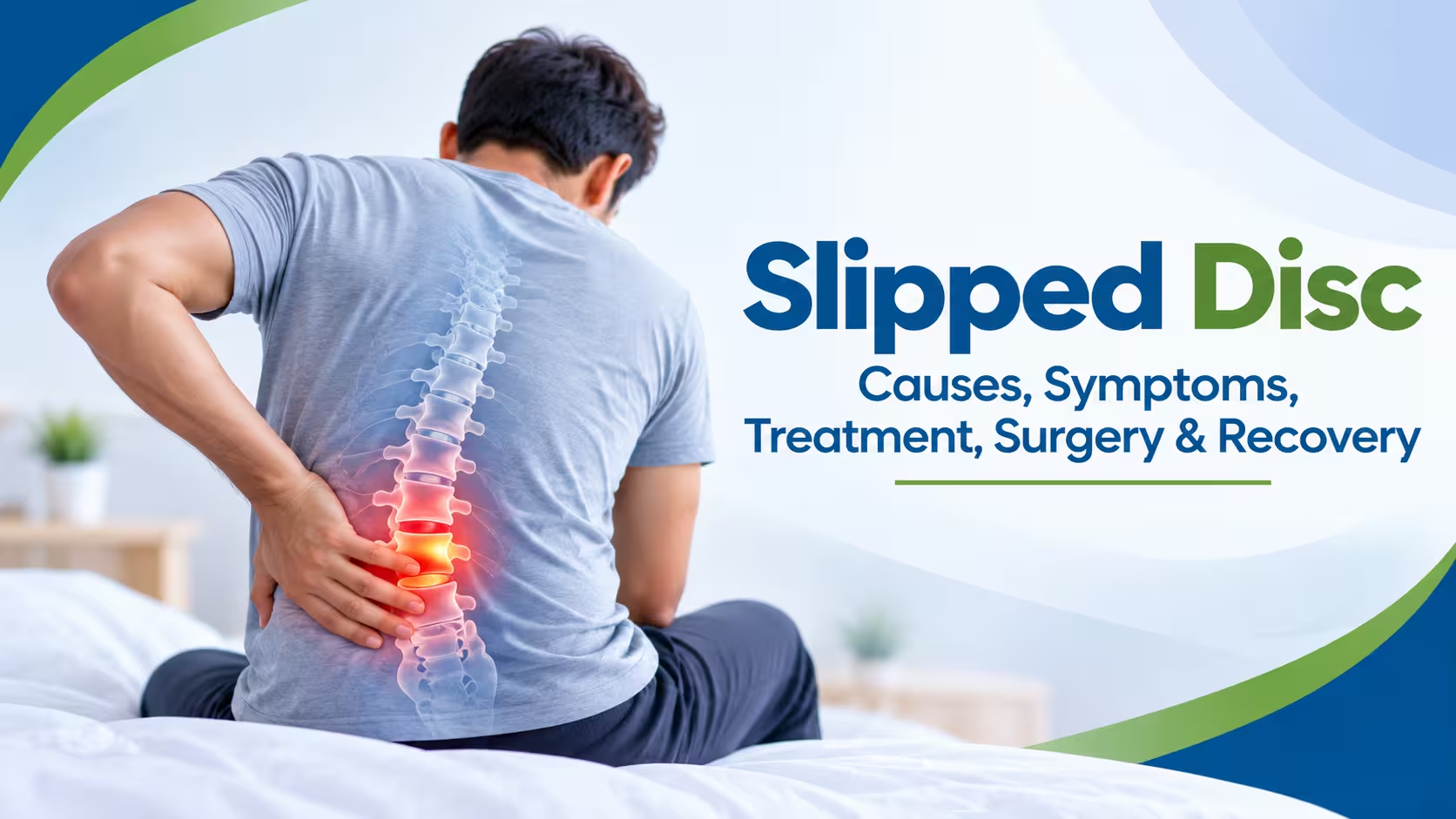
A slipped disc, also called a herniated disc or disc prolapse, occurs when the soft inner material of a spinal disc pushes through a weakened or damaged outer layer. If the disc material irritates or compresses a nearby nerve, it can cause back or neck pain, pain travelling into the leg or arm, numbness, tingling, or muscle weakness.
Most slipped discs occur in the lower back, although they can also develop in the neck. Treatment depends on the location of the disc problem, severity of symptoms, nerve involvement, and how much the condition affects daily activities.
In many cases, treatment starts with non-surgical approaches such as medication, physiotherapy, activity modification, and targeted exercises. Surgery may be considered when symptoms are severe, persistent, or associated with significant nerve compression or neurological weakness.
What Is a Slipped Disc?
The spine consists of multiple vertebrae separated by flexible structures called intervertebral discs.
These discs work as cushions between the vertebrae and help the spine absorb movement and load.
A disc has:
- A strong outer layer called the annulus
- A softer inner portion called the nucleus
When the outer layer becomes weak or develops a tear, the inner material can bulge or move outward. This is commonly referred to as a slipped disc.
The displaced disc material may irritate nearby nerves and result in symptoms such as:
- Back or neck pain
- Leg or arm pain
- Tingling
- Numbness
- Muscle weakness
A slipped disc does not always cause symptoms. Some people may have a disc bulge seen on an imaging scan without experiencing significant pain.
What Are the Symptoms of a Slipped Disc?
Symptoms depend on the location of the affected disc and whether a nerve is being compressed.
1. Lower Back Pain
A lumbar slipped disc may cause pain in the lower back.
The pain can sometimes become worse with:
- Bending
- Sitting
- Coughing
- Sneezing
- Lifting
- Certain movements
2. Pain Travelling Into the Leg
When a lower-back disc irritates a nerve, pain may travel from the lower back into the:
- Buttocks
- Thigh
- Calf
- Foot
This type of radiating pain is commonly associated with sciatica.
3. Neck and Arm Pain
A slipped disc in the cervical spine may cause pain in the:
- Neck
- Shoulder
- Arm
- Hand or fingers
Some people describe the pain as sharp, burning, or electric-like.
4. Numbness or Tingling
Nerve irritation can cause a pins-and-needles sensation or reduced sensation.
Depending on the affected nerve, these symptoms may occur in the:
- Arm
- Hand
- Leg
- Foot
5. Muscle Weakness
Significant nerve compression can affect muscle strength.
You may notice difficulty with activities such as:
- Lifting objects
- Walking normally
- Climbing stairs
- Maintaining grip
- Moving the affected limb
Muscle weakness should not be ignored because it may indicate more significant nerve involvement.
What Causes a Slipped Disc?
A slipped disc can develop gradually due to changes in the spinal discs or suddenly following an injury.
Common risk factors include:
Age-Related Disc Degeneration
As we age, spinal discs can gradually lose water content and flexibility. This can make them more susceptible to damage.
Heavy Lifting
Lifting heavy objects using incorrect technique can place considerable stress on the spine.
Repeated lifting, especially with bending and twisting, may increase the risk of disc injury.
Sudden Injury or Trauma
A fall, accident, sports injury, or sudden force can sometimes damage a spinal disc.
Poor Posture
Prolonged poor posture can increase stress on the spine, particularly when sitting for long periods.
Being Overweight
Excess body weight can increase the mechanical load placed on the lower back and may contribute to disc degeneration.
Smoking
Smoking is associated with poorer spinal disc health and may affect the body's ability to repair damaged tissues.
Genetic Factors
Some people may have a higher susceptibility to disc degeneration due to genetic factors.
How Is a Slipped Disc Diagnosed?
A spine specialist generally starts with your medical history and a physical examination.
The doctor may assess:
- Pain location
- Muscle strength
- Reflexes
- Sensation
- Walking pattern
- Spine movement
- Neurological symptoms
MRI Scan
An MRI is commonly used when a doctor needs detailed information about the spinal discs, nerves, and surrounding structures.
It can help identify:
- Disc bulge
- Disc herniation
- Nerve compression
- Spinal stenosis
- Other structural abnormalities
Not every person with back pain requires an MRI. Imaging is usually recommended based on symptoms and examination findings.
How Is a Slipped Disc Treated?
The appropriate treatment depends on the severity of symptoms and whether there is nerve compression or neurological weakness.
Treatment can broadly be divided into non-surgical and surgical approaches.
Non-Surgical Treatment for Slipped Disc
Many patients can improve with conservative treatment.
Medications
Doctors may prescribe appropriate medicines to manage pain and inflammation.
Medication should be taken only according to medical advice, particularly if you have other medical conditions or take other medicines.
Physiotherapy
Physiotherapy can play an important role in recovery.
A physiotherapist may recommend exercises designed to:
- Improve mobility
- Strengthen core muscles
- Improve posture
- Reduce strain on the spine
- Improve functional movement
The exercise programme should be based on the patient's symptoms and diagnosis.
Activity Modification
You may need to temporarily modify activities that worsen your symptoms.
This does not necessarily mean prolonged bed rest. In many cases, appropriate movement and gradual return to activity are part of recovery.
Lifestyle Changes
Lifestyle modifications can include:
- Improving sitting posture
- Avoiding incorrect heavy lifting
- Maintaining a healthy weight
- Exercising regularly
- Stopping smoking
- Taking regular breaks from prolonged sitting
Epidural or Nerve Root Injections
For selected patients with persistent nerve-related pain, a doctor may consider an injection around the affected nerve or spinal region.
These injections may help reduce inflammation and provide temporary pain relief in appropriate cases.
They are not suitable for everyone and should be considered after a proper evaluation.
When Is Surgery Needed for a Slipped Disc?
Surgery is not automatically required for every slipped disc.
A spine specialist may consider surgery when:
- Severe pain persists despite appropriate conservative treatment
- There is significant or progressive muscle weakness
- Nerve compression is causing disabling symptoms
- Symptoms significantly interfere with daily activities
- There is serious neurological involvement
- There is loss of bladder or bowel control
The decision is based on the patient's symptoms, examination findings, imaging results, overall health, and response to non-surgical treatment.
Slipped Disc Surgery Options
Depending on the location and characteristics of the disc problem, different surgical techniques may be considered.
Microdiscectomy
A microdiscectomy is a minimally invasive procedure used to remove the portion of a herniated disc that is compressing a nerve.
It may be considered for selected patients with persistent nerve-related symptoms such as leg or arm pain, numbness, or weakness.
Endoscopic Spine Surgery
Endoscopic spine surgery uses a small camera and specialized instruments to access the affected area through a relatively small incision.
For appropriately selected patients, minimally invasive techniques may reduce tissue disruption and may allow an earlier return to normal activities.
Laminectomy
A laminectomy involves removing part of the bone forming the back portion of a vertebra to create more space for compressed nerves.
It may be used when nerve compression is associated with conditions such as spinal stenosis or other degenerative changes.
Spinal Fusion
Spinal fusion joins two or more vertebrae to create a stable spinal segment.
It may be considered when instability or other structural problems are present along with the disc condition.
Fusion is not required simply because a patient has a slipped disc; the indication depends on the individual spinal problem.
Artificial Disc Replacement
In selected cervical or lumbar cases, an artificial disc may be considered after removing a damaged disc.
The aim is to maintain motion at the treated spinal level rather than permanently fusing the vertebrae.
Whether disc replacement is appropriate depends on factors such as the patient's age, spinal anatomy, degeneration, instability, and overall diagnosis.
Slipped Disc Treatment Cost in Gurgaon
The cost of slipped disc treatment in Gurgaon can vary significantly depending on the treatment required.
Factors that may affect the overall cost include:
- Consultation charges
- Diagnostic tests
- MRI or other imaging
- Medicines
- Physiotherapy
- Injections, if required
- Type of surgery
- Surgical technology
- Hospital charges
- Surgeon fees
- Anaesthesia
- Post-operative rehabilitation
Non-surgical treatment is generally less expensive than surgery, while the cost of surgery varies according to the procedure and hospital.
For an accurate estimate, patients should undergo a clinical evaluation first because the treatment required cannot be determined from the diagnosis name alone.
Slipped Disc Recovery and Rehabilitation
Recovery depends on the severity of the disc problem and the treatment required.
A rehabilitation programme may include:
Gradual Movement
Appropriate movement and walking may be encouraged as advised by your doctor.
Physiotherapy
Exercises may gradually focus on:
- Core strengthening
- Flexibility
- Posture
- Spinal stability
- Functional movement
Ergonomic Correction
Patients may be advised on proper:
- Sitting
- Standing
- Lifting
- Sleeping
- Workplace ergonomics
Gradual Return to Activities
Returning to work, exercise, sports, and heavy physical activity should be gradual and guided according to recovery.
Do not resume strenuous activity simply because your pain has temporarily improved.
How to Prevent a Slipped Disc
Although not every disc problem can be prevented, maintaining good spinal health may help reduce risk.
Exercise Regularly
Strengthening the core, hips, and back muscles can help support the spine.
Choose exercises appropriate for your fitness level and medical condition.
Maintain Good Posture
When sitting:
- Keep your back supported
- Keep your feet comfortably positioned
- Avoid prolonged slouching
- Keep your screen at an appropriate height
Lift Objects Correctly
When lifting:
- Bend your knees.
- Keep the object close to your body.
- Use your legs rather than bending from your waist.
- Avoid twisting while lifting.
Take Breaks From Sitting
If your work requires prolonged sitting, take regular movement breaks.
Standing, walking, and changing positions can help reduce prolonged spinal loading.
Maintain a Healthy Weight
Maintaining a healthy weight can reduce excessive mechanical stress on the spine.
Avoid Smoking
Stopping smoking can benefit overall health and may also support better spinal health.
What Is the Difference Between a Slipped Disc and Sciatica?
A slipped disc and sciatica are related but they are not the same thing.
| Slipped Disc | Sciatica |
|---|---|
| A structural problem involving a spinal disc | A nerve-related pain pattern |
| Disc material may bulge or herniate | Pain follows the sciatic nerve pathway |
| Can occur in the neck or lower back | Usually affects the lower back and leg |
| May cause local pain or nerve symptoms | Commonly causes pain travelling from the lower back/buttock into the leg |
| May or may not cause symptoms | Usually refers to symptoms caused by irritation/compression of the sciatic nerve |
| Can be diagnosed with clinical assessment and imaging when indicated | Diagnosis is primarily clinical, with imaging used when appropriate |
A slipped disc can be one of the causes of sciatica, but sciatica can also occur due to other conditions such as spinal stenosis or bone spurs.
When Should You See a Spine Specialist?
You should consider a professional evaluation if you have:
- Persistent back or neck pain
- Pain travelling into an arm or leg
- Repeated numbness or tingling
- Muscle weakness
- Difficulty walking
- Difficulty maintaining grip
- Increasing stiffness or restricted movement
- Symptoms that are worsening rather than improving
Seek Immediate Medical Attention If You Have:
Loss of bladder or bowel control, numbness around the groin or saddle area, or rapidly developing significant weakness can indicate serious nerve compression and requires urgent medical evaluation.
Do not wait for home treatment to work if these warning signs occur.
Dr. Dheeraj Batheja – Spine Surgeon
If you are experiencing persistent back pain, leg pain, numbness, tingling, or weakness due to a suspected slipped disc, an accurate diagnosis is important before deciding on treatment.
Dr. Dheeraj Batheja is an experienced Spine Surgeon in Gurgaon with 13+ years of experience, having treated 25,000+ patients and performed 5,000+ spine surgeries.
His expertise includes the evaluation and treatment of conditions such as:
- Slipped Disc
- Herniated Disc
- Sciatica
- Cervical Disc Problems
- Lumbar Spine Conditions
- Spinal Stenosis
- Nerve Compression
- Minimally Invasive Spine Conditions
- Endoscopic Spine Problems
Treatment is selected according to the patient's diagnosis and symptoms. Many patients can be managed without surgery, while selected cases may require minimally invasive or other surgical procedures.
Frequently Asked Questions About Slipped Disc
What is a slipped disc?
A slipped disc occurs when the inner material of a spinal disc pushes through a weakened or damaged outer layer and may irritate nearby nerves.
What are the most common slipped disc symptoms?
Common symptoms include back or neck pain, pain travelling into the leg or arm, numbness, tingling, and muscle weakness.
Can a slipped disc heal without surgery?
Yes. Many patients can improve with appropriate non-surgical treatment, depending on the severity and symptoms.
How long does a slipped disc take to recover?
Recovery varies from person to person. Some patients improve over several weeks with conservative treatment, while more severe cases may take longer or require additional treatment.
Is walking good for a slipped disc?
Gentle walking may be beneficial for many patients, but the appropriate level of activity depends on the symptoms and diagnosis.
Can physiotherapy treat a slipped disc?
Physiotherapy can help selected patients improve mobility, strength, posture, and function. The exercises should be tailored to the individual's condition.
When does a slipped disc require surgery?
Surgery may be considered when symptoms remain severe despite appropriate conservative treatment, or when there is significant or progressive neurological weakness or other serious nerve compression.
Is a slipped disc the same as sciatica?
No. A slipped disc is a structural disc problem, while sciatica describes symptoms caused by irritation or compression of the sciatic nerve. A slipped disc can cause sciatica.
Can a slipped disc cause numbness and weakness?
Yes. If a herniated disc compresses a nerve, it can cause numbness, tingling, and muscle weakness in the area supplied by that nerve.
Which doctor treats a slipped disc?
An Orthopaedic Spine Specialist or Spine Surgeon can evaluate a slipped disc and recommend appropriate treatment based on the patient's symptoms and diagnosis.
Latest Article
What Causes Neck Pain After Waking Up
How to Manage Cervical Pain
What Are the Symptoms of Severe Lower Left Back Pain?
Which Exercises Are Safe for Cervical Spondylosis?