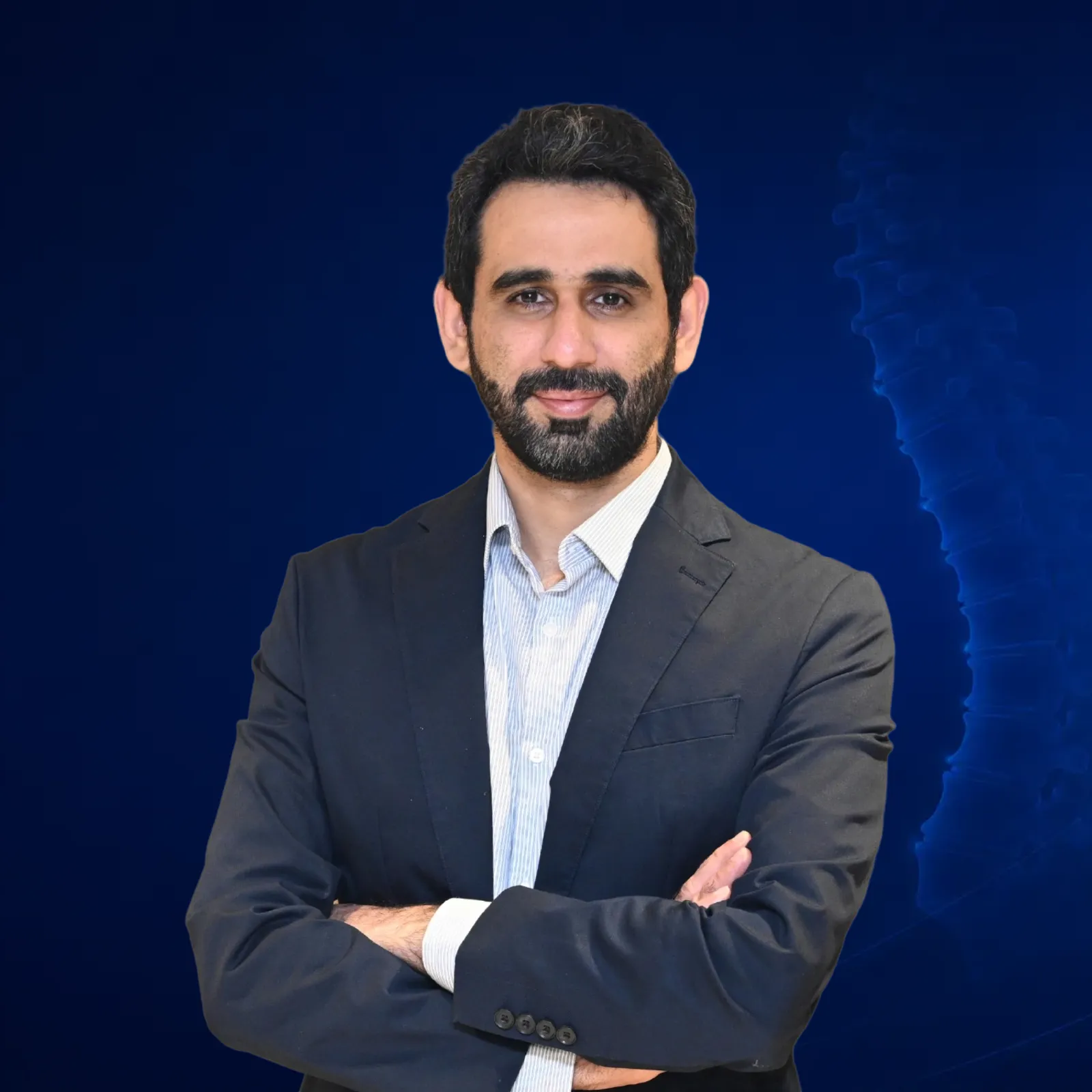
Patients from Delhi can consult Dr. Dheeraj Batheja in Gurugram for evaluation and treatment of selected spinal conditions that may be suitable for minimally invasive or endoscopic spine surgery. Dr. Batheja is a Senior Consultant – Ortho Spine Surgery at Artemis Hospitals, Gurugram, with 13+ years of clinical experience and more than 5,000 spine surgeries.
If you are experiencing persistent back pain, leg pain, sciatica, numbness, weakness, or symptoms related to a slipped disc or spinal stenosis, a detailed clinical assessment and appropriate imaging can help determine whether surgery is required and which treatment approach may be suitable.
Senior Consultant – Ortho Spine Surgery
Minimally invasive spine surgery (MISS) uses smaller access points and specialised instruments to treat selected spinal conditions while aiming to limit unnecessary disruption to surrounding muscles and tissues.
However, minimally invasive surgery is not appropriate for every spinal condition or every patient. The recommended procedure depends on the diagnosis, severity of nerve compression or spinal instability, imaging findings, previous treatment, and the patient's overall health.
Minimally invasive spine surgery is a group of advanced techniques designed to treat selected spinal conditions through smaller access points compared with conventional open procedures.
Specialised instruments and, in some procedures, an endoscopic camera allow the surgeon to work around the affected spinal structures while reducing unnecessary tissue disruption.
The objective is not simply to use a smaller incision. The important consideration is whether a minimally invasive approach can safely and effectively address the underlying spinal problem.
Depending on the patient's diagnosis, minimally invasive or endoscopic techniques may be considered for:
A herniated disc occurs when disc material presses against a nearby spinal nerve, causing back or neck pain, radiating pain, numbness, tingling, or weakness. Many cases improve with non-surgical care. When symptoms persist, microdiscectomy or endoscopic discectomy may be considered.
Sciatica involves pain travelling along the sciatic nerve into the leg, often accompanied by burning, tingling, or leg weakness. Surgery is not automatically required, but when significant compression persists, minimally invasive decompression or discectomy relieves nerve pressure.
Narrowing around the spinal canal or nerve root exits can cause back pain, leg pain, numbness, weakness, and difficulty standing or walking for extended periods. In appropriate patients, minimally invasive decompression techniques help relieve pressure on affected nerves.
An advanced technique using a small camera and specialised instruments to access and treat disc herniations and nerve compression through a tiny incision. Dr. Batheja is listed by Artemis Hospitals as an endoscopic spine surgery specialist in Gurgaon.
Minimally invasive spine surgery may be considered for patients who present with:
Diagnosis begins with a detailed clinical assessment before choosing any treatment approach:
Comprehensive discussion of symptoms, pain radiation, duration, previous treatments, and functional difficulties.
Assessing spinal mobility, muscle power across muscle groups, sensation, reflexes, and nerve tension stretch signs.
Investigations to confirm disc herniation, structural spinal narrowing, and exact nerve compression levels.
Determining whether conservative management, minimally invasive surgery, or endoscopic surgery is the safest approach.
Dr. Dheeraj Batheja is a Senior Consultant – Ortho Spine Surgery at Artemis Hospitals, Gurugram, with extensive expertise in advanced keyhole and endoscopic spine procedures.
His clinical practice focuses dedicatedly on spinal conditions and surgical treatment, including minimally invasive and endoscopic procedures.
He has performed more than 5,000 spine surgeries according to his Artemis Hospitals profile and clinical practice records.
Qualifications include MBBS from Maulana Azad Medical College, Delhi, MS Orthopaedics from UCMS, DNB, MNAMS, and MRCS. He also completed spine-focused clinical training in the UK and an AO Global Spine Diploma under AO Spine, Davos, Switzerland.
His practice focuses on modern spine procedures, including minimally invasive and endoscopic techniques. Artemis also lists him among its endoscopic spine surgery specialists in Gurgaon.
Treatment depends on symptoms, examination, imaging, and diagnosis. Non-surgical options are prioritized when appropriate, and when surgery is indicated, the approach is selected based on individual anatomy.
Recovery varies according to the type of surgery performed, the spinal condition being treated, the extent of nerve compression, the patient's overall health, and whether the procedure is endoscopic, decompression, fusion, or another technique. Some minimally invasive procedures allow earlier mobilisation and a quicker return to routine activities, but recovery should not be assumed to follow a fixed timeline.
Patients from Delhi can consult Dr. Dheeraj Batheja in Gurugram for evaluation of spinal conditions and discussion of treatment options. Dr. Batheja's consultation and surgical care are provided in Gurugram at Artemis Hospitals.
The important distinction is that Delhi is the patient-location target, while Gurugram is the actual consultation and treatment location. Patients travelling from South Delhi, Dwarka, West Delhi, Central Delhi, and across the NCR can easily arrange their consultation in Gurugram.
Consultation Location: Artemis Hospital Road, Sector 51, Gurugram, Haryana 122018
Detailed information for patients from Delhi seeking minimally invasive spine evaluation and treatment in Gurugram.
Yes. Patients from Delhi can consult Dr. Dheeraj Batheja for spine conditions. His consultation and surgical practice are based in Gurugram at Artemis Hospitals.
Depending on the diagnosis, minimally invasive techniques may be used for selected cases of slipped or herniated disc, sciatica caused by nerve compression, spinal stenosis and other conditions requiring decompression or selected spinal procedures.
Not necessarily for every patient. Minimally invasive techniques can reduce tissue disruption and may offer recovery advantages in appropriately selected cases. However, the safest and most effective approach depends on the individual spinal condition.
Like any surgery, minimally invasive spine surgery has potential risks. The risks and expected benefits depend on the specific procedure, diagnosis and patient. A detailed consultation is required before surgery.
There is no single recovery period for all minimally invasive spine procedures. Recovery depends on the operation performed and the patient's condition. The surgeon provides procedure-specific instructions and guidance regarding return to normal activities.
Yes. Dr. Batheja's current consultation and treatment location is in Gurugram. Patients from Delhi who wish to consult him should plan to visit Gurugram for evaluation and treatment.
Yes. Many slipped disc cases can initially be managed conservatively. Depending on symptoms and clinical findings, treatment may include medication, physiotherapy and activity modification. Surgery is considered when there are appropriate clinical indications.
Bring previous MRI/CT scans, X-rays, prescriptions, medical reports and a list of current medications, if available. This can help the doctor assess your previous diagnosis and treatment.
If you are experiencing persistent back pain, sciatica, a slipped disc, spinal stenosis or another spine-related problem, an appropriate diagnosis should come before deciding on surgery. Patients from Delhi can consult Dr. Dheeraj Batheja in Gurugram for evaluation and discussion of suitable treatment options, including minimally invasive and endoscopic spine procedures where medically appropriate.
Consultation Clinic: Artemis Hospital Road, Sector 51, Gurugram, Haryana 122018